
ODM Jewelry Development: What the Factory Hands Back
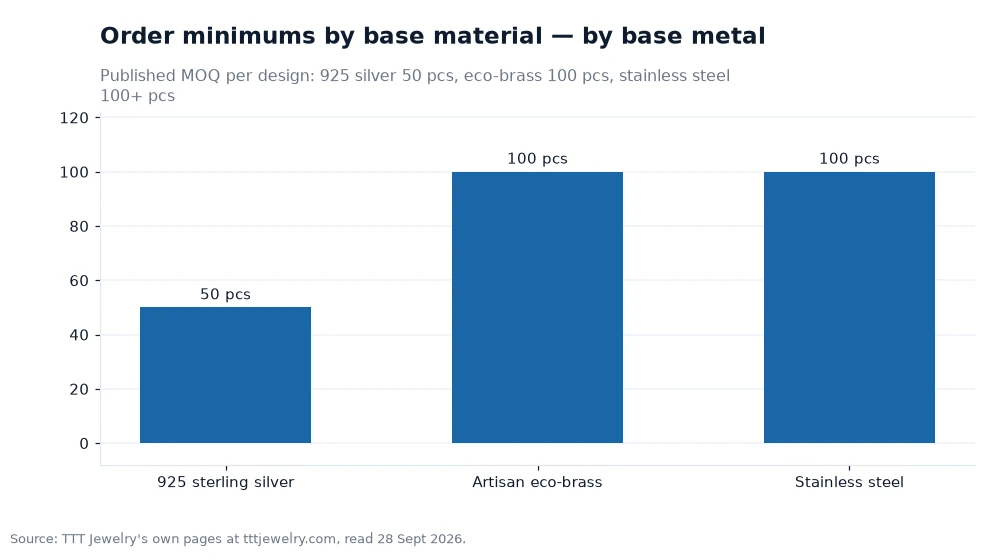
An OEM/ODM programme ends with more than finished jewelry. The brand receives an approved master, a production reference sample, a pack specification and a documented material list. TTT Jewelry runs that handover inside 25–30 days of sampling and 21–28 days of bulk, and the quantity behind it depends on the metal: 50 pieces per design in 925 sterling silver, 100 in artisan eco-brass.

Key takeaways
- Four deliverables matter: approved master, reference sample, spec sheet and pack proof.
- Sampling takes 25–30 days; bulk takes 21–28 days at 100% inspection.
- The silver floor of 50 pieces per design is 50% of the brass floor of 100.
- Exclusivity covers moulds, CAD and the collection, not just the finished design.
The handover list
Brands that order ODM development often focus on the jewelry and ignore the objects that make the jewelry repeatable. The repeatable part is the handover: a master, a specification, a packing standard and a record of what the brand owns.
TTT Jewelry describes its ODM route as concept-to-finished development, with the resulting collection exclusive to the brand. That promise only holds if the paperwork behind it arrives too. A factory that hands back a beautiful bracelet and no specification has given the brand a product, not a supply line.
List the deliverables before the purchase order, not after. It is far easier to ask what will be handed over while the quote is still being negotiated than to request a master six months later when the design has moved to a second run.
What arrives with the master sample
The master arrives after 25–30 days, made in the specified metal with the specified finish and plating. Alongside it should come four pieces of information: the final dimensions, the plating specification including colour and karat, the stone list with sizes and setting method, and the inspection criteria the bulk run will be measured against.
Ask for photographs on a neutral background and under bench light. The two look different, and the bench-light image is closer to what a customer sees in a store. A master photographed only in a lightbox can hide plating streaks that appear under warmer retail lighting.
For silver and brass, the master should be judged after anti-tarnish e-coating. The coat is a clear barrier over the plate, and on brushed surfaces it can soften texture slightly. Approving an uncoated piece means approving a surface that will not ship.
What stays in the factory and what the brand owns
The mould usually stays with the factory because that is where casting happens, but custody is not ownership. The distinction matters on a reorder, on a design change and on the day the relationship ends.
CAD files are the portable asset. A brand holding STEP and native files can reproduce the piece elsewhere; a brand holding only photographs cannot. Ask for the files at handover rather than assuming they will be supplied on request later.
This is where a bespoke jewelry OEM production agreement should be specific. TTT Jewelry states that moulds, CAD and the collection are not resold or shown to other buyers. A clause covering derivatives closes the obvious gap, since a small modification is still recognisably the same design.
Minimums by metal
The handover quantity follows the material. Silver carries the lowest published floor because the metal value per unit is higher and buyers test designs in smaller batches. Brass and stainless sit at 100 or more per design.
| Base material | Minimum per design | Plating route | Typical use |
|---|---|---|---|
| 925 sterling silver | 50 pieces | Rhodium or gold plate, anti-tarnish coat | Test runs, premium capsules |
| Artisan eco-brass | 100 pieces | 14K/18K/24K gold, anti-tarnish coat | Colour-led fashion ranges |
| 316L stainless steel | 100+ pieces | PVD vacuum plating | Daily-wear, waterproof designs |
Read the table as a per-design rule, not an order total. Four designs in brass means 400 units before packing, and the number does not fall because the designs are small.
Receiving what lands on the dock
The bulk delivery should be checked against the reference sample rather than against a memory of it. Three checks catch most problems: colour against the master under the same light, dimensions at the points named in the spec, and the packing against the approved proof.
TTT Jewelry closes production with 100% inspection, so every piece is checked at the factory before dispatch. That does not remove the need for a receiving check. It shifts the question from "is any piece defective" to "does this batch match the approved reference", which is a different test and the one a brand is positioned to run.
A documented material list matters as much as the visual check. REACH compliance and CA Prop 65 conformity for plating are claims about substances, and they can only be verified against a record of what was used, not against the look of the finished piece.
ISO 9001:2015 stage control is what makes that record credible: each production stage has a defined check, and the final inspection is the last of them rather than the only one.
Worked example
Take a three-metal capsule. The brand wants two silver designs, three brass designs and two stainless designs. Applying the published minimums: 2 × 50 = 100 silver pieces, 3 × 100 = 300 brass pieces and 2 × 100 = 200 stainless pieces. Total commitment: 600 units.
Compare the floors directly. Silver at 50 is 50/100 = 50% of the brass minimum, so a silver design can be tested at half the brass quantity. That is why a brand unsure about a silhouette often develops it in silver first and scales the winner into brass later.
Now trim the capsule. Cutting one stainless design removes 100 pieces, taking the order to 500 and saving one mould, one plating set-up and one packing specification. Cutting one silver design removes only 50 pieces but the same amount of administrative work, which is why small silver runs are efficient in units and inefficient in overhead.
Time the handover. Sampling at 30 days plus production at 28 days plus CAD at 2 days gives 60 days. In hours, 48 + 720 + 672 = 1,440. The three designs in brass share the same sampling window, so the calendar stays at 60 days while the unit count triples.
Frequently asked questions
What should a brand receive at the end of ODM development?
An approved master in the final metal and finish, a reference sample, a written specification covering dimensions, plating and stones, a pack proof, and the CAD files. Exclusive rights to the design should be confirmed in the agreement.
Does the brand own the mould?
The factory normally keeps physical custody because casting happens there, but ownership is contractual. Confirm in writing that the mould, CAD and collection are not reused or shown to other buyers, including modified versions.
How many pieces must a first ODM order cover?
The floor is 50 pieces per design in 925 sterling silver, 100 in artisan eco-brass and 100 or more in stainless steel, counted per design rather than across the order.
Handing over a supply line, not just a product
The test of an ODM programme is what happens on the second order. If the master, the files and the pack proof are in hand, the repeat run needs only a quantity and a date. If they are not, the brand pays for development twice.
Brands planning to widen the range should ask for the custom jewelry wholesale terms at the same time, since volume pricing and repeated designs are usually negotiated together rather than separately.
It also helps to know who at TTT Jewelry holds the file set. A named project manager is a small detail with a large effect when a reorder is needed two seasons later and the original contact has moved on.
Development is finished when the brand can reproduce the piece without the factory's memory. Everything handed back should serve that end.
Source note: figures come from the manufacturer's own website (tttjewelry.com), read 28 Sept 2026.[1]